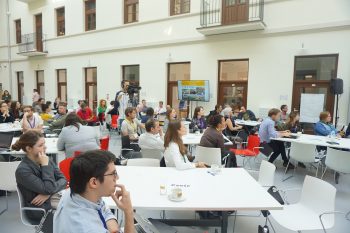
On February 23 Iván Tosics, Olga Müller, and Judit Kálmán from MRI presented the ESPON URDICO project (https://www.espon.eu/projects/urdico-urban-dimension-cohesion-policy-and-other-eu-programmes), which was completed in January, to the National Development Center – TOP Plus Managing Authority and the Ministry of Public Administration and Regional Development. The presentation focused primarily on interesting foreign best practices, such as the operational program targeting metropolitan areas in Italy (NOP Metro), the functioning of integrated territorial investments (ITI) in five countries, functional urban area cooperation examples in Warsaw, Prague and Strasbourg, integrated neighborhood development programs in Ghent, and targeted social development programmes in the southern part of Rotterdam. These examples were of particular interest to the participants, as Hungary will soon be planning its next EU planning cycle, in which proven foreign experiences can be helpful. It is hoped that the foreign best practices and the comments on the distribution and use of cohesion funds in Hungary and Budapest will help in the preparation of Hungary’s programs for the next EU cycle.
Egyéb
Ending Homelessness in Central & Eastern Europe with a Housing-led Approach – invitation to the online Report launch event, where Nóra Teller will be one of the presenters
The Metropolitan Research Institute has contributed together with The Budapest Institute to the soon to be published new report of World Habitat Ending homelessness in Central and Eastern Europe: Making the shift to a housing-led system.
The online launch event will be at 9.30am – 11.00 (BST) / 10.30 – 12.00 (CEST) on Monday 18 September, where our colleague Nora Teller will be one of the presenters.
Register to the event here.
MRI works on a feasibility study of housing-led responses in the CEE countries together with Budapest Institute
We are excited to share, that the World Habitat comissioned MRI and the Budapest Institute to work on a feasibility study of innovative housing-led solutions in the CEE countries.
For further details click here.
MRI organising storytelling workshops with local young people and local experts on housing, employment and education in Pécs
On 22 and 23 June 2022 MRI organised storytelling workshops in Pécs within the frame of our UPLIFT project, with the participation of local young people and local experts and practitioners. After having done the qualitative research phase of the project, including 40 interviews with local young people and several interviews with local experts on housing, education and employment, these workshops intended to share the stories we have heard and put together to challenge some of our early conclusions before finalizing the local case study report on Pécs.
We organized three separate group discussions: 1) with some of the young people with whom we have made the interviews, 2) with local experts and practitioners in the field of education (school director, expert on programmes for young people with learning difficulties, experts from Tanodas and social institutes) and 3) with local experts and practitioners on housing (homelessness service providers, social institutes).
We have invited some of our young interviewees for a group discussion about some of the main points that were drawn from all the interviews with young people. Our discussions were based on pre-defined questions letting the participants build their own narrative which we are able to compare with our concluding observations on their possibilities and actual capabilities in the field of education, employment and housing. This method helped us find common pathways that seemed to be more likely based on common socio-economic situations.
- In housing: The conversation affirmed that there are seemingly unbridgeable gaps between the public rental sector and the private rental market, and between the private rental market and the owner-occupied market.
- In employment: The statement said by many experts that ‘all who want to have a job can have it in Pécs’ was proved to be rather overgeneralizing, hiding main barriers of accessing a desired labour market position: like being Roma, having a child or children. Moreover social capital and informal mechanisms seem to be crucial in discovering different opportunities in the labour market, which, even if determined by status, constitutes a more effective labour market asset than institutionalised opportunities such as those provided by the Employment Office.
- In education: The discussion on educational possibilities and experiences reinforced the picture that the segregated nature of the institutional system in Pécs results in a strong path dependency of school choices (e.g. from elementary to secondary), and the limitations of institutions such as Tanodas that are complementing the school system, e.g. in regard to age groups.

The methodology was somewhat different in the meeting with local experts and practitioners in the field of education, where three focal points were defined: the capacity of the local education system to create opportunities, cooperation between schools, and early school leaving in late adolescence. The conclusion of the meeting was that most of the problems root in the ‘resource space’, the current national educational system that strengthens school segregation and creates competing institutions instead of collaborating ones. Education was considered as a part of a social system in which social disadvantages should be treated from birth. It was also emphasised that teacher education must be reformed concentrating more on pedagogical skills and the freedom of educational methodologies. Finally our assumption was strengthened that there are practically no services for young people above 14-16 years – in case they do not have a child. It seems to be a lost age group, in that aspect.

In the workshop with local housing experts and practitioners we have discussed the following statement, which we have found to be describing the essence of housing problems in Pécs: ‘The main problem is the deep gap between the different housing positions. If there is no possibility to move from one position to another, then perverse behaviours occur to stay safe in the current position.’ Local experts have reassured that the municipal stock is rather rigid: it is unlikely to exit if one got access to a municipal flat; both the system seems not motivating for leaving the municipal sector and both the local market rental sector seems to be unwelcoming especially with people from the Roma community and families with children, while entering to the public rental sector is very limited and impenetrable as eligibility criteria is rather unclear and again informality seems to be playing an important role.

These main points will be further analysed in the upcoming Case Study Report on Pécs.
Critical Housing Analysis: Issue 2020/1 released – edited by József Hegedüs
The special issue “Varieties of Housing Regime Approaches” edited by József Hegedüs aims to discuss different theoretical concepts and their empirical relevance. It represents a unique collection of seven papers written by leading housing researchers in this field.
7th Informed Cities conference: Who profits from heritage?
OpenHeritage project, led by Metropolitan Research Institute, organized its first international event in Warsaw in October 2019, in the framework of the Informed Cities Forum series, in cooperation with ICLEI – Local Governments for Sustainability, and the Actors of Urban Change network.

The 7th Informed Cities forum was a two-day event called “Who profits from heritage? Communities, capital and urban space”. It took place on 15-16 October, and explored the interrelation between urban regeneration and heritage, reflecting on the importance of community involvement and the creation of a heritage community. The latter is a crucial building block of all successful projects. As Katarzyna Sadowy of OpenHeritage partner Warsaw Association of Polish Architects (OW SARP) pointed out in her keynote speech, “heritage doesn’t exist without the heritage community – people who make the buildings, places, stories part of their identity”.
Building on the experience of the OpenHeritage project and the Actors of Urban Change community, the Forum explored new ideas and tools to empower local communities and safeguard urban commons. The realities, challenges and successes of urban regeneration were illustrated through a series of field workshops organised by local partners representing the public, private and community sectors in Warsaw. The workshops explored community-managed spaces; partnerships for creative districts; the future of urban peripheries; mapping values using heritage; and modern placemaking.
The event gathered more than 100 participants, who were a mix of urban activists, social entrepreneurs, local and European policy makers, researchers and investors.