On 29 May, 2026, the results of the European Homelessness Counts (EHC) conducted across 35 cities is presented. The discussion explores key lessons learned from the project, speakers share practical experiences from selected cities, and reflect on the overall process and impact of the initiative.
Participants will gain insights into different methodologies, common challenges, and good practices that can help inform future homelessness counts and policy development.
Speakers & 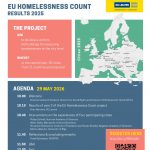 Moderator:
 Katarina Ivanković Knežević, Director for Social Rights and Inclusion, DG EMPL, European Commission Koen Hermans, Researcher LUCAS KU Leuven, EHC project team Philipp Schnell, Researcher, Austrian Academy of Sciences Albert Sales Campos, Researcher, Metropolis Institute Barcelona Stoyanka Cherkezova/Mateva, Researcher, Institute of Population and Human Studies, Bulgarian Academy of Sciences Kārlis Lakševics, Researcher, University of Riga Freek Spinnewijn, Director, FEANTSA Nora Teller, Researcher MRI, EHC project team
 Register here: https://events.teams.microsoft.com/…/c5b1735b-c971-452d…
 More about the EU – Homelessness Counts: https://www.kuleuven.be/lucas/en/eu_homelessness_counts
Social inclusion
SOLACE-CEE Project launched
On October 1, six civil organizations, including providers from Slovakia, Bulgaria, Poland, Romania, and Hungary, launched the development and testing of innovations aimed at integrating social and healthcare services for homeless people. The project is led by the DEDO Foundation in Košice, with MRI responsible for monitoring and impact assessment. Read more at https://mri.hu/en/solace-cee/
‘Urban poverty and the pandemic’ in URBACT by Iván Tosics
Iván Tosics has published an article in URBACT website on raising the importance of local solutions for the social and economic affects of the Covid-19 crisis that is hitting the poorest. Tosics explores in this article what URBACT’s role could be on finding local solutions.
The full article is available in English on this link.
A new H2020 Project, coordinated by MRI, was just kicked-off in Budapest
UPLIFT project – “Urban PoLicy Innovation to address inequality with and for Future generaTions” (2020-2022) coordinated by MRI – has successfully launched on 28-29 January in a kick-off meeting organized in Budapest.
The UPLIFT project aims to understand the main drivers of urban socio-economic and spatial inequalities focusing mainly on the younger generation (15-29) in the post-crisis area. The analysis will be done on four levels: (1) understanding the relation between socio-economic inequalities and spatial inequalities on European level, (2) understanding how local policies are able to influence urban inequalities in a sample of 16 functional urban areas, (3) analysing by means of interviews with vulnerable young and policy experts how local policies are in interaction with household decisions in 8 cities. As a result of all these analyses, UPLIFT will create – with the active involvement of vulnerable youth – local Reflexive Policy Agendas: new local policies that are more sensitive to the changing needs of the target group. This co-creation process will be carried out in 4 locations: Amsterdam (NL), Barakaldo (ES), Sfântu Gheorghe (RO), and Tallinn (EE).
HomeLab: closing conference in Budapest
Te closing conference of HomeLab – Integrated Housing and Labour Services in the Social Rental Enterprise model – will take place on 26-27 September 2019, in European Youth Centre Budapest.
HomeLab was launched in 2016, and aimed at providing integrated social, housing and employment services to vulnerable, often multiply excluded target populations in the four “Visegrad” countries (Czechia, Hungary, Poland, and Slovakia). The closing conference, final event of a three year experimental and research project, assesses the difficultues and achievements of both the pilot projects, and the research stream of HomeLab, looking in particular at the promises and challenges of integrated service provision to excluded socio-economic groups. In the sessions from Thursday morning until Friday early afternoon discussants will look at innovations in housing and employment support, in social accompaniment strengths and deficiencies in the Central and Eastern European context, and on the ways in which integrated support measures may fold out in a mutually supporting manner.
The full programme is available on this link.
HomeLab: National Workshop in Budapest
A national workshop was organised in Budapest in the framework of HomeLab project, with the participation of a broad range of actors and partners from the two Hungarian pilots; and with numerous public policy officials from across the country. The event titled “Integrated housing and employment services in the Social Rental Enterprise model”, co-organised by Metropolitan Research Institute and Budapest Institute, attracted 58 participants from across the country.